
Is Forex Trading Legal in Malaysia, Laws, Licenses, Risks
Forex trading is legal for individuals in Malaysia, but the legality of the platform matters far more than the trade itself. Regulators target unauthorized operators, fixed-return schemes and pooled deposits, while clients of unlicensed offshore brokers lose local protection, complaint routes and any realistic chance of recovery.
Bank Negara Malaysia oversees banks and foreign exchange rules, the Securities Commission covers capital market products, and a Labuan license does not authorize retail solicitation in Malaysia. The repealed Exchange Control Act 1953 was replaced by the Financial Services Act 2013 and BNM's foreign exchange notices, which govern money movement rather than banning trading.
The article lists scam warning signs, such as guaranteed returns, recruitment rewards, personal-account payments and recovery-fee offers, and advises reporting scams via 997. Readers should verify brokers on the SC register and BNM alert list, remembering that a missing warning is not an approval. It also covers LHDN taxation, Islamic rulings on swaps, age and identity rules, and risk habits such as demo practice, stop-losses, small starting deposits and early withdrawal tests.
You hear two stories about trading currencies in Malaysia. One says it is a normal way to earn extra income. The other says people lose their savings to scams and get warnings from regulators. Both are true, which is why you need to know where the legal line sits before you deposit a single ringgit.
You hear two stories about trading currencies in Malaysia. One says it is a normal way to earn extra income. The other says people lose their savings to scams and get warnings from regulators. Both are true, which is why you need to know where the legal line sits before you deposit a single ringgit.
Short answer: forex trading in Malaysia is legal for individuals, but the platform you use matters. Bank Negara Malaysia (BNM) governs foreign exchange under the Financial Services Act and its foreign exchange policy, and the Securities Commission (SC) regulates capital market products. Many offshore brokers are not licensed locally, and that is where most of the trouble starts. Trading with an unlicensed operator is not the same as trading through a regulated one.
Below, we explain which rules apply to you, what BNM and the SC actually require, and how to spot illegal forex schemes such as guaranteed-return pledges and unlicensed managed accounts. You will also get a practical checklist for verifying a broker, so you can start with confidence and keep your capital safe.
Why the legality of forex trading matters in Malaysia
Legality is not a technicality. It decides whether you can get your money back, whether a regulator will act on your complaint, and whether your deposit reaches a real broker or a scammer.
The trade is rarely the problem, the operator is
Many beginners ask, is forex legal in Malaysia, and expect a plain yes or no. The answer has two parts. Individuals can trade currencies, and forex trading is legal in Malaysia when you do it through an authorized provider. What the law targets is offering forex margin or investment services to the public without authorization. So the legal exposure sits mostly with the operator, while the financial exposure lands on you.
Online access blurs this. A company registered offshore can accept a Malaysian client in minutes, so asking whether online forex trading is legal in Malaysia really means asking who sits on the other side of your trade. Many offshore brokers are lawful in their home country yet hold no Malaysian authorization. Registration abroad does not give you local protection.
The trade is rarely the problem. The unauthorized operator behind it usually is.
What you stand to lose with an unlicensed operator
Illegal forex trading in Malaysia usually describes the operator's conduct, not yours, but you are the one who pays for it. Here is how that shows up in practice:
- No dispute route. Licensed institutions answer to Malaysian regulators and recognized complaint channels. An unlicensed offshore firm does not.
- Withdrawal trouble. Deposits go in easily. Withdrawals then meet delays, surprise fees or demands for a "tax" payment.
- Weak fund safety. Nothing forces the firm to keep your money separate from its own.
- Slow or impossible recovery. Chasing a company abroad often costs more than a small account holds.
Why small accounts feel this most
Take a typical beginner. You see a broker offering a $1 minimum deposit, 1:3000 leverage and a welcome no deposit bonus. The offer may be real, and some brokers behind such offers are properly regulated elsewhere. Still, tiny deposits and extreme leverage attract exactly the schemes regulators warn about, and a small trader has the least room to absorb a frozen account.
Headlines add to the confusion. When you read that forex trading is illegal in Malaysia, the story is almost always about a scheme promising fixed returns or an unauthorized firm taking public deposits. If you wonder whether forex trading is illegal in Malaysia for you personally, the later sections on the Exchange Control Act and the BNM alert list give you the specifics.
How to trade forex legally in Malaysia
Legal trading starts with one habit: check the authorization before you check the spreads. Whether forex trading in Malaysia is legal for you in practice depends on who holds your money, so work through the steps below in order.
A five-step check before you deposit
- Name the entity. Get the full legal name and registration number of the company that will hold your account, not just the brand on the website.
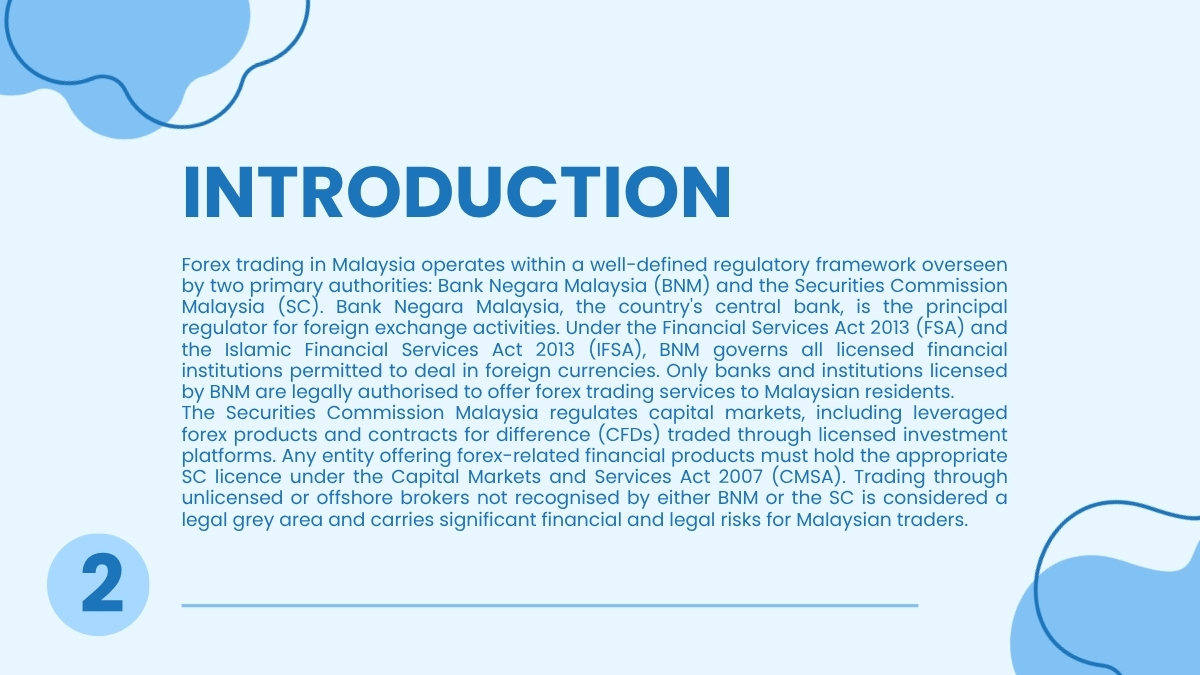
- Look for Malaysian authorization. Ask whether Bank Negara Malaysia (BNM) or the Securities Commission (SC) has licensed or approved it.
- Confirm on the regulator's own site. Never rely on a license badge in the broker's footer.
- Read the client agreement. Look for fund segregation, the governing law and the withdrawal terms.
- Test with a small deposit. Withdraw part of it before you add more.
This takes about 20 minutes. It is the cheapest protection you will ever buy as a trader.
Verify the operator's authorization first. Everything else about a broker comes second.
Which routes are safest, and which carry more risk
The cleanest routes are licensed Malaysian banks that offer foreign exchange services under BNM rules, and SC-regulated intermediaries for exchange-traded derivatives on Bursa Malaysia. Both answer to a local regulator, so you have a complaint channel if something goes wrong.
Many retail traders use offshore brokers instead. Here the picture is less tidy. A broker regulated by a foreign authority is not the same as one authorized in Malaysia, so you do not get local protection. Choosing one is a personal risk decision, and you should treat it as higher risk than a local route. If you go that way, favor the safest brokers picked by professional traders, with a clear regulator abroad, segregated client funds and published withdrawal terms. Rules and approvals change, so check BNM and SC notices again before you commit.
Also keep your own paper trail. Save the client agreement, deposit receipts and chat records. If a dispute starts, those files are your evidence, and a regulator or bank can only act on what you can show.
What the Exchange Control Act 1953 says about forex
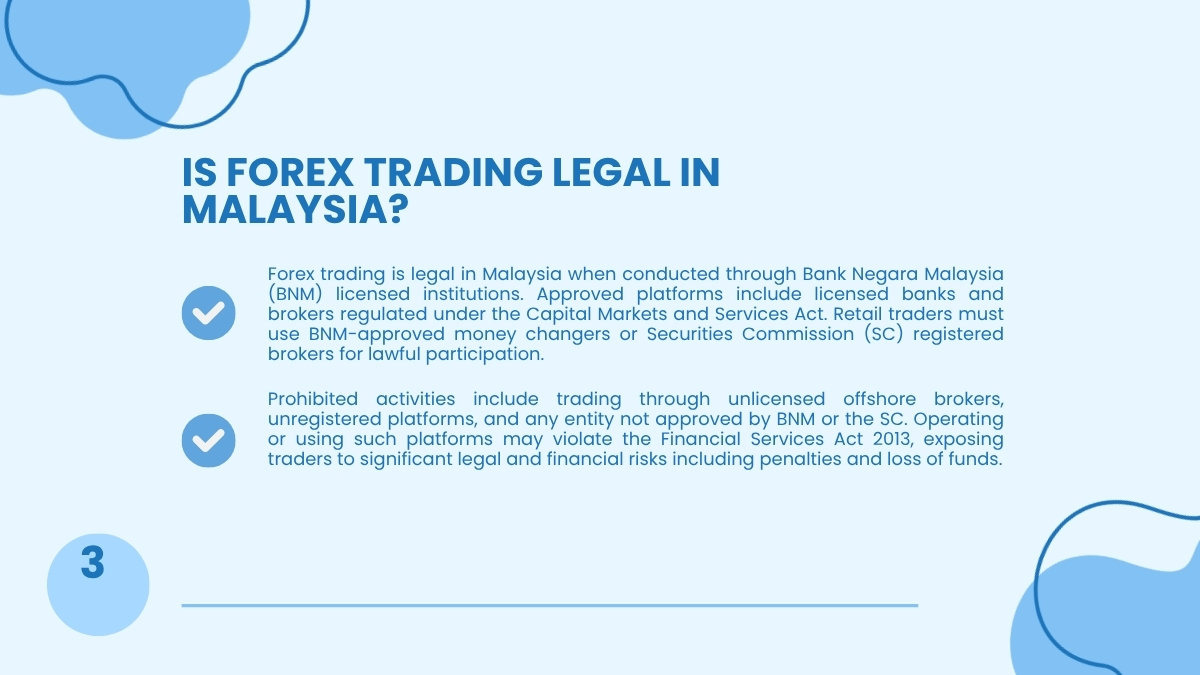
You will still see the Exchange Control Act 1953 cited on broker pages and in forum threads. That citation is outdated. The Act was repealed in 2013, when the Financial Services Act 2013 (FSA) and the Islamic Financial Services Act 2013 took over. Today the foreign exchange administration (FEA) rules sit in those laws and in BNM's FEA notices.
What the old Act actually did
The Exchange Control Act gave Bank Negara Malaysia power to control how money moved across the border. It was about capital flows and the ringgit, not about banning individuals from trading currencies. Nothing in it said a resident could not hold or trade foreign currency. So when you ask whether forex trading is legal in Malaysia, the old Act never gave a flat "no", and the FEA rules that replaced it do not either.
Malaysian foreign exchange rules govern how money moves, not whether you may trade.
The FEA rules that affect you today
The table below summarizes the points a retail trader meets most often. Rules are updated from time to time, so confirm the current wording on BNM's website.
| Rule area | What it means for you |
|---|---|
| Residency | FEA rules differ for residents and non-residents. Most Malaysian traders are residents. |
| The ringgit | Offshore trading of the ringgit and ringgit speculation with non-residents are restricted. |
| Domestic ringgit borrowing | If you owe ringgit credit to a local bank, limits can apply to investing in foreign currency assets abroad. |
| Foreign currency accounts | Residents can generally hold foreign currency accounts with licensed onshore banks. |
Put this to work. Avoid funding offshore trading with a ringgit loan or a credit card cash advance, because borrowing is exactly where the limits can bite. If you are unsure whether your own situation is covered, ask your bank or BNM's public inquiry channel before you transfer funds. Doing so costs nothing, and it keeps a simple trading decision from turning into a compliance problem.
Who regulates forex: Bank Negara, SC and licensed dealers
Three authorities shape the answer when you ask whether forex trading in Malaysia is legal on a given platform. Each covers a different slice of the market, so a license from one does not stand in for another. Knowing which body oversees what tells you where to look when you verify a provider.
Who covers what
| Authority | What it oversees | What it means for you |
|---|---|---|
| Bank Negara Malaysia (BNM) | Banks, money services businesses and foreign exchange administration rules | Your route for spot currency services through licensed banks and the FEA notices |
| Securities Commission (SC) | Capital market products under the Capital Markets and Services Act 2007, including derivatives on Bursa Malaysia | Your route for regulated futures and exchange-traded products |
| Labuan FSA | Financial firms licensed in the Labuan International Business and Financial Centre | Often the license behind an offshore broker, but not a Malaysian retail authorization |
Licensed dealers and the Labuan question
Licensed banks and approved dealers are the clearest legal counterparties for currency services. Money changers licensed by BNM under the Money Services Business Act 2011 handle physical currency exchange. That license does not cover margin trading, so a money changer offering leveraged CFDs should raise a red flag.
Labuan causes the most confusion. Many offshore brokers advertise a Labuan license and imply that it makes them Malaysian and approved. A Labuan license does not automatically authorize a firm to solicit retail clients across Malaysia. Always check what the license permits and who it permits it for.
A license only protects you if it covers the service you are buying and the country you live in.
Finally, remember that regulators publish their own lists. BNM and the SC both keep public registers of authorized firms, plus warning lists of unauthorized ones. Use those, not the broker's footer, and the next sections show you how.
Why some forex trading is called illegal in Malaysia
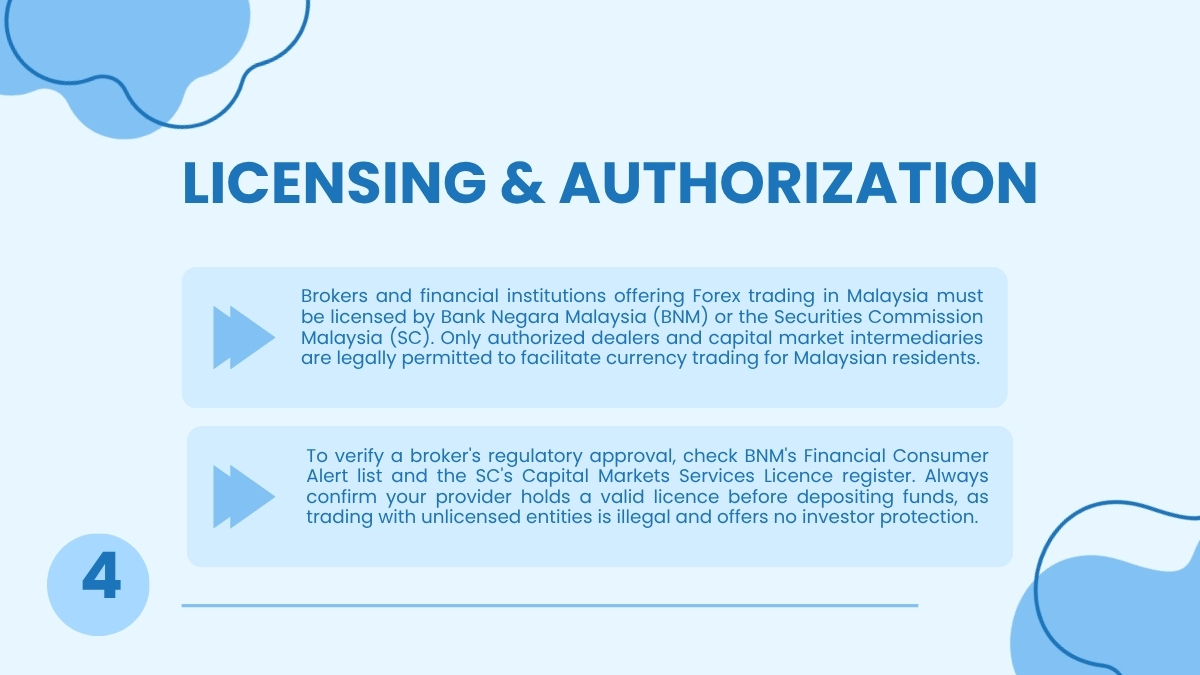
Search results can make forex trading illegal in Malaysia sound like the general rule. It is not. The label usually attaches to specific conduct by an operator, and rarely to a resident who simply opens an account with an authorized provider. Three situations account for most of the warnings you read.
The three situations behind the label
Regulators act when a business crosses a line, not when an individual places a trade. The table shows the common cases and who carries the risk.
| Situation | Why it is called illegal | Who carries the risk |
|---|---|---|
| Unauthorized margin or CFD dealing | A firm solicits Malaysian clients without the authorization the service requires | The operator legally, you financially |
| Fixed-return or managed-fund schemes | A promoter takes public money and promises returns without approval | The operator and promoters, then you through lost deposits |
| Breaches of foreign exchange rules | Examples are ringgit dealings the rules restrict, or misuse of borrowed ringgit | Whoever breaches the rule |
The second row does the most damage. A "forex fund" that pays 10% a month is not trading. It is usually paying old investors with new deposits, and the currency market is only the story that sells it. Real trading cannot promise fixed returns, because price moves cannot be guaranteed.
Where you stand personally
Being a client of an unauthorized firm is generally not the same as committing an offense. Your main problem is practical: no local protection and little hope of recovery. Promoters are different. If you recruit friends for commission into a scheme that has no authorization, you can move from victim to participant with legal exposure. Get independent legal advice before you take any role like that.
Ask what the operator did, not whether currencies can be traded. The first question decides legality.
Next time a headline says forex trading is illegal in Malaysia, run three quick checks. Who is the operator? What exactly was promised? Was money collected from the public? If the story involves guaranteed returns, unlicensed fund management or pooled deposits, it describes a scheme. If it describes an ordinary account at an authorized provider, the legal position is the one covered earlier in this guide.
How to spot illegal forex schemes and scams
Because forex trading in Malaysia is legal through authorized providers, scammers borrow the language of legitimate trading. The pitch sounds professional, but the structure behind it is not. Learn the patterns and you can walk away before you deposit.
Warning signs in the pitch
Most schemes share a handful of tells. One is a reason to pause, and two together are close to conclusive.
- Guaranteed or fixed returns. "5% a week, no risk" cannot exist when prices move both ways.
- Pressure to act fast. "Only 10 slots left" or "bonus ends tonight" is built to stop you from checking.
- Rewards for recruiting. Paying you to bring friends points to a pyramid structure.
- Payment to a person. Legitimate firms take deposits into company accounts, not personal accounts or crypto wallets.
- Fake credentials. License numbers that match no register, or copied regulator logos.
- Unsolicited contact. A "mentor" on Telegram, WhatsApp or a dating app who found you.
Scam formats you will meet
The packaging changes, but the table below covers most illegal forex trading in Malaysia that reaches retail victims.
| Format | How it works | Tell |
|---|---|---|
| Managed account or "forex fund" | You hand over money and an "expert" trades it | A fake dashboard shows profit, but you cannot withdraw |
| Signal group or mentor | A chat group pushes you to one specific broker | The broker is unlicensed and the mentor earns commission |
| Romance investment | A new online friend "teaches" you to trade | They never meet you and always ask for more |
| Recovery service | After you lose money, an "agent" offers to get it back | They demand an upfront fee |
The common thread is control of your money. If someone else holds your login or your funds, you are not trading, you are trusting.
Real trading always carries risk, so a promise of no risk is the scam itself.
What to do if you spot one
Stop sending money at once. Save every screenshot, receipt and chat message, then contact your bank to ask about stopping or recalling the transfer. Speed matters, so do this the same day.
Next, report it. You can call the National Scam Response Centre at 997, file a police report, and notify BNM or the SC so the operator can be assessed for their warning lists. Ignore anyone who offers to recover your losses for a fee. That is usually the second scam aimed at the same victim.
How to verify a broker and check the BNM alert list
Checking whether forex trading in Malaysia is legal with a specific broker comes down to three public registers, and each takes a few minutes. Do this before you deposit, and again if the broker changes its name or its operating entity.
The lookup, step by step
- Search the SC register. On the Securities Commission site, look up the firm among licensed and registered persons. Dealing in derivatives requires a Capital Markets Services Licence.
- Check BNM's lists. Bank Negara Malaysia publishes its Financial Consumer Alert List, which names unauthorized entities and websites. It also keeps registers of licensed institutions.
- Search every name. Try the brand, the legal entity and the website address. Scammers clone names and swap domains.
- Confirm any foreign license. If the broker cites an offshore regulator, find the firm on that regulator's own register. Match the entity name and license number exactly.
- Save the evidence. Screenshot each result with the date and keep it with your client agreement.
What the alert list does and does not tell you
Appearing on an alert list is a clear stop sign. Regulators add names after complaints or findings of unauthorized activity, so if your broker is listed, withdraw your funds and walk away. Lists change often, so check on the day you plan to deposit, not last month.
Absence is a different matter. Many scam sites are brand new and not listed yet, so a clean result proves nothing on its own. Only a positive match on a licensing register counts as confirmation.
A missing warning is not an approval. Only a match on a licensing register is.
Still unsure after your searches? Call BNMLINK at 1-300-88-5465 and ask whether the entity is authorized for the service you want. Treat any answer you cannot confirm as a no, and look for another provider among the top-rated forex brokers for 2026.
Taxes, Islamic rulings and other rules for Malaysian traders
Legal status is only the start. Even when forex trading in Malaysia is legal, your profits, your beliefs and your account habits still come with rules.
How forex profits are taxed
Malaysia has no general capital gains tax on an individual's investment gains, so the real question is whether the Inland Revenue Board (LHDN) sees you as running a business. Occasional trades usually look like investing. Frequent, organized, leveraged trading can be treated as business income under the Income Tax Act 1967. LHDN weighs how often you trade, how long you hold, and whether you trade for profit as a routine. Rules on foreign-sourced income have also changed in recent years, so confirm the current position with LHDN or a tax adviser.
Keep these records from day one:
- Monthly statements and full trade history
- Deposit and withdrawal receipts
- Ringgit conversion rates on the dates you moved money
Keep every statement, because LHDN decides how your trading is taxed, not your broker.
Also remember that a real broker never asks for a "tax" payment before releasing your withdrawal. That demand is a scam signal.
Islamic rulings on forex
Sharia acceptability is a separate question from legality. Many scholars accept spot currency exchange when settlement is immediate, but rollover interest (swap) and leverage funded by interest-bearing credit raise objections.
Swap-free "Islamic accounts" exist at many brokers. Some scholars doubt they solve the underlying issues, especially if the broker adds fees that replace the swap. Opinions differ, so ask a qualified scholar you trust. Malaysia's Sharia advisory councils review local financial products, and they do not vouch for offshore brokers.
Other rules that apply to you
A few practical rules catch beginners off guard:
- You must be 18 or older to open a trading account.
- Brokers run identity checks under anti-money laundering rules, so expect to submit ID and proof of address.
- Fund from accounts in your own name. Third-party payments often trigger frozen withdrawals.
Never lend your account or trading login to anyone. Criminals use such accounts to move stolen money, and you may be questioned as part of a money laundering investigation.
Risks of forex trading and how to protect your money
Even when forex trading in Malaysia is legal, the market can still cost you money. Legality tells you who answers to a regulator. It says nothing about whether your trade will win.
The risks that hit beginners hardest
Leverage is the biggest one. At 1:500, a price move of just 0.2% against you can wipe out your entire margin. European regulators make brokers publish the share of losing retail accounts, and those figures commonly sit between 70% and 80%. Treat that as a fair picture of what beginners face, wherever you live.
| Risk | What it looks like | How to limit it |
|---|---|---|
| Leverage | A small move triggers a margin call | Size positions so one loss costs 1% to 2% of your account |
| Slippage and spreads | Fills at worse prices during news | Stay out of major data releases until you have experience |
| Overtrading | Revenge trades after a loss | Set a daily loss limit and stop when you hit it |
| Bonus conditions | Profits locked behind trading volume | Read the withdrawal terms before you claim |
| Broker failure | Frozen funds or a collapsed firm | Check fund segregation and the regulator |
Habits that protect your capital
Risk control is mostly routine, not talent. Build these habits before your first live trade:
- Practice on a demo account until you can follow a written plan for a month.
- Use a stop-loss on every trade, set before you enter.
- Risk only money you can afford to lose. Never use rent money, a ringgit loan or a credit card advance.
- Start small and withdraw early. A successful withdrawal proves the broker pays.
- Turn on two-factor authentication and never share your login.
You cannot control the market, but you can control how much any single trade is allowed to cost you.
Finally, keep a trading journal. Note why you entered, where you set your stop and how you felt. After 30 trades, the pattern in your mistakes will teach you more than any signal group, and it will show you whether this is a sensible side activity or a habit to pause.
What to remember before you trade
Whether forex trading in Malaysia is legal for you comes down to the operator, not the trade. Individuals can trade currencies, but regulators act against unauthorized firms, fixed-return schemes and pooled deposits.
Before you deposit, verify the entity on the SC register and the BNM alert list, and remember that a missing warning is not an approval. Test a small withdrawal early, keep your records for LHDN, and risk only money you can afford to lose. Legal does not mean profitable.
Ready to compare brokers with those checks in hand? See our 5 best forex brokers compared side by side for minimum deposits, leverage and execution models, then run your own verification before you open an account.