
This XM Forex Broker Review checks account options
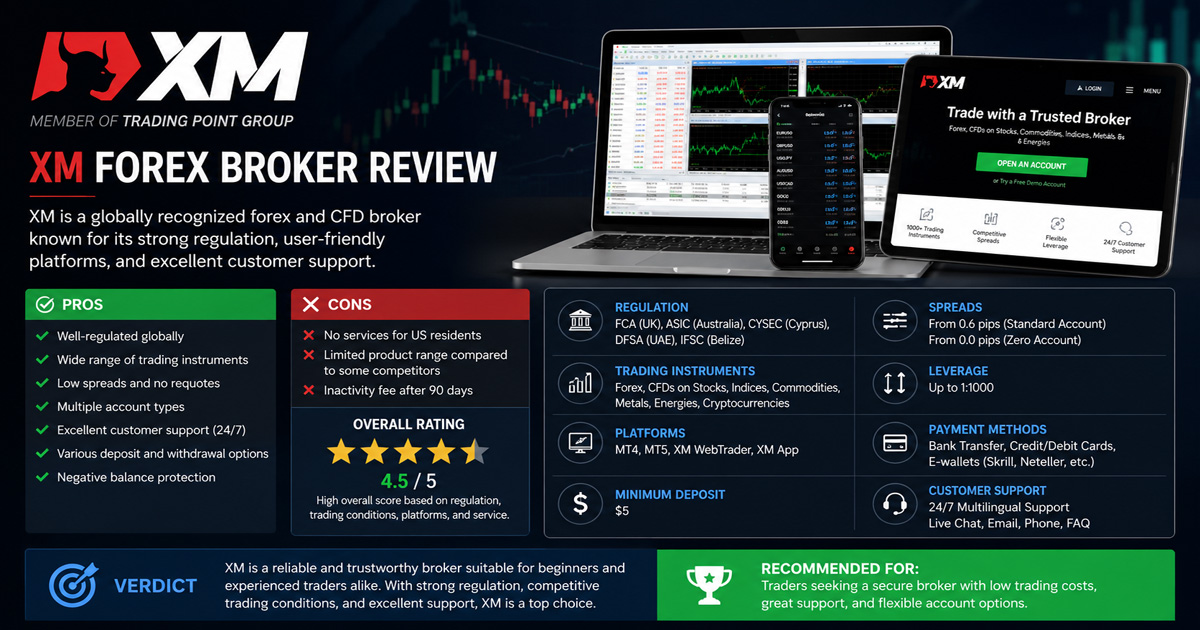
XM Broker Review The Truth About Trading Costs and Platform Performance
At the time I set out to complete this XM broker review, I wanted to test whether XM Group's bold promises matched reality.
The numbers look appealing on the surface: a $5 minimum deposit, access to over 1,400 trading instruments, and a claimed zero requotes policy on over 10.3 billion executed trades.
Low entry barriers often hide costs elsewhere, of course.
We'll get into XM trading costs in detail, put their platform performance to the test, and determine whether XM forex broker delivers genuine value or just clever marketing.
What Is XM Broker And Who Should Use It
XM operates as a global forex and CFD broker under the parent company Trading Point Holdings Ltd, which launched operations in 2009. The broker has grown from a Cyprus-based startup to a multi-entity operation serving over 15 million clients across 190+ countries.
Company Background Since 2009
Trading Point Holdings created XM as a global forex brokerage in 2009. The UK's FSA and major EU regulatory authorities granted the company registration status in 2010. Mobile trading followed in 2011. The brokerage acquired XEMarkets.com in 2012 and purchased the domain XM.COM as a shortened version of XEMarkets in 2013.
The client base expanded faster than expected. XM exceeded 500,000 clients by 2015 and climbed to 700,000 by 2016. The broker reached the 1,000,000 clients milestone in 2017, the same year it launched the Multi-Asset MetaTrader 5 platform. World Finance 100 listed XM among the 100 industry-leading companies that year. The broker has since executed over 10.3 billion trades.
XM pioneered a strict no requotes, no rejections policy that became central to its reputation. 99% of all trades execute in less than one second to prevent slippage and line up strategies with immediate market prices. XM provides liquidity directly to clients as a market-maker, which enables fast execution with deep liquidity pools.
XM Global Limited And Multi-Entity Structure
XM serves clients through separate entities tailored to specific regions. Trading Point of Financial Instruments Ltd handles EEA countries. Trading Point of Financial Instruments Pty Ltd serves Australian clients. Trading Point MENA Limited, regulated by the Dubai Financial Services Authority, caters to Middle East traders. XM Global Limited manages international clients from the rest of the world.
This multi-entity structure reflects the broker's strategy to comply with regional regulations while maintaining global reach. Each entity operates under different regulatory frameworks, which affects protection levels and trading conditions based on your location.
Target Users: From Beginners To Active Traders
XM positions itself for traders across experience levels, though the fit depends on your specific needs and location.
Beginner forex traders find value in the $5 minimum deposit requirement, which allows testing live trading without substantial financial risk. The broker provides educational resources, daily webinars and XM TV for continuous learning. Negative balance protection prevents catastrophic losses from leverage mistakes. Micro and Standard accounts accommodate small position sizes for those starting out.
Casual traders in emerging markets benefit from XM's presence in Africa, the Middle East and Southeast Asia where broker options remain limited. The platform supports local payment methods and customer support in 30 languages. XM provides reliable market access for regions with restricted access to Western brokers.
Mobile-first traders who trade from phones get a polished experience through the XM App, which delivers more functionality than generic MT4/MT5 mobile apps. Active traders focusing on education appreciate the daily sessions and complete learning materials that exceed what most brokers offer.
XM focuses on CFDs and forex, which are leveraged products carrying high risk. The broker does offer real stocks besides CFDs, but 74.3% of retail investor accounts lose money when trading CFDs with this provider. European traders receive solid regulatory protection, while offshore clients rely more on the company's reputation than legal safeguards.
XM Broker Regulation And Safety Standards
Regulatory oversight determines what protections you receive when you trade with XM. The broker's multi-entity structure means your safeguards depend on which legal entity serves your region entirely.
CySEC And Top-Tier Licenses
Trading Point of Financial Instruments Ltd operates under CySEC license number 120/10. This entity serves European Economic Area clients with strict MiFID II compliance standards. The Cyprus-based entity earned authorization from the UK's Financial Conduct Authority (firm reference number 705428) and maintains passporting registrations in nine European jurisdictions. These include BaFin in Germany, CNMV in Spain, CONSOB in Italy and ACPR in France.
Australian traders fall under Trading Point Australia Pty Ltd. ASIC regulates this entity with license number 443670. Trading Point MENA Limited holds DFSA authorization (reference F003484) for Middle East operations. The industry classifies these as top-tier or Tier-1 regulators. They provide the highest protection standards.
The regulatory picture changes for international traders outside these regions. XM Global Limited operates under FSC Belize license 000261/397. Other offshore entities hold licenses from FSA Seychelles and FSC Mauritius. These fall into lower regulatory tiers with less stringent oversight. South African clients receive service through an FSCA-regulated entity (license 49976). This regulator is classified as Tier-2 and provides moderate protection.
Your residency determines entity assignment. European clients gain access to stricter retail protections and leverage caps. Traders in regions served by offshore entities access higher leverage but lighter regulatory safeguards.
Client Fund Protection And Segregation
XM maintains client funds in segregated bank accounts. These accounts are separate from company operational capital across all entities. The accounts sit with reputable banking institutions in Germany and Switzerland. Creditors cannot access client money even during company insolvency.
Under CySEC regulation, eligible retail clients receive coverage through the Investor Compensation Fund up to €20,000 per person. This compensation scheme activates if the broker faces financial collapse or cannot make customers whole on account balances. Australian clients benefit from similar protection schemes that ASIC mandates.
Client funds remain excluded from the company's balance sheet. Regular audits verify compliance with segregation requirements. Findings are reported to the issuing regulatory authority directly. For accounts held outside the UK or EU, the legal regime that applies to the custodian bank may differ. This could affect protection effectiveness compared to equivalent UK institutions.
Negative Balance Protection Across All Entities
XM provides negative balance protection universally. This prevents losses beyond your account balance whatever entity serves you. When volatile market movements push your account into negative territory, XM absorbs the loss and resets your balance to zero.
This protection applies to all seven account types XM offers. These include Standard, Micro, Ultra Low Account variants and the Shares Account. The mechanism works when you deposit funds into a negative balance account automatically. The system may reset balances to zero without deposits if you hold no open positions.
The protection extends to all trading instruments. These include forex pairs, precious metals, equity indices, commodities, energies, cryptocurrencies and stocks. European regulators including ESMA, ASIC and the FCA mandate negative balance protection for retail clients. XM extends this safeguard globally even where not required legally.
Trust Score And Reputation Analysis
ForexBrokers.com assigned XM's parent company Trading Point Group a Trust Score of 93 out of 99. The rating was developed through proprietary metrics that measure regulatory licenses and operational history. The rating reflects authorization from four Tier-1 regulators, three Tier-2 regulators and three Tier-4 regulators.
DayTrading.com's evaluation confirmed authorization from one 'green tier' regulator (CySEC) and three 'yellow tier' regulators (DFSA, SCA, FSCA). The broker also holds three 'red tier' regulators (FSC Belize, FSC Mauritius, FSA Seychelles). FXTrustScore improved XM's rating to 78.9% in 2026, up from 57% in 2025.
Trustpilot reviews present a mixed picture. The broker has 3.8 out of 5 stars across over 2,500 reviews. About 46% rate the service five stars, while 31% assign one star. Complaints concentrate on withdrawal delays and spread widening during volatile markets. Independent rating sites assign higher marks based on regulatory standing and operational track record.
XM Trading Costs Breakdown: Spreads, Commissions And Hidden Fees
Trading costs separate profitable traders from those who bleed capital through fees. XM uses a variable spread model in all account types. Spreads fluctuate based on current liquidity and volatility. They narrow under normal conditions but widen during major news releases, political uncertainty, or weekend sessions when liquidity drops.
Standard Account Spreads From 1.6 Pips
The Standard Account charges spreads starting from 1.6 pips on major forex pairs like EUR/USD with zero commission. Average spreads run higher at 2.0 pips for EUR/USD, 2.0 pips for USD/JPY, and 2.6 pips for GBP/USD. Gold spreads average 3.6 pips.
Actual dollar costs work like this: trading one standard lot of EUR/USD with a 1.6 pip spread equals $16. The formula breaks down as 100,000 units × 0.0001 × 1.6 pips = $16. Traders executing 20 round-turn lots monthly face Standard Account costs totaling $640 in spread expenses alone.
Ultra Low Account: Tighter Spreads At 0.8 Pips
Ultra Low accounts cut spreads in half compared to Standard pricing. EUR/USD spreads start at 0.8 pips, with averages around 1.0 pip. GBP/USD averages 1.3 pips, while USD/JPY maintains a 1.0 pip average. Gold tightens to 1.6 pips average.
The difference compounds faster for active traders. A scalper executing 20 trades daily at 0.1 lot on EUR/USD pays $20 per day with Ultra Low versus $40 daily on Standard. Over 20 trading days, that's $400 versus $800 monthly, saving $400 just from account selection.
XM Zero Account: Raw Spreads With $7 Commission
Zero accounts provide raw interbank spreads starting at 0.0 pips on major forex pairs. But XM charges a $7 commission per standard lot round turn, calculated as $3.50 per side.
A three-lot USD/JPY position (300,000 units) generates $21 in commission, charged upfront when opening the trade. Comparing one standard lot EUR/USD reveals total costs across account types: Zero Account shows 0.2 pip spread plus $7 commission totaling $11, Ultra Low costs $22 with 1.1 pip spread and no commission, while Standard runs $40 with a 2.0 pip spread.
Zero accounts deliver the lowest total cost to high-volume traders, though the commission structure adds complexity to cost calculations.
Swap Rates And Overnight Fees
XM applies rollover interest at 22:00 GMT for positions held overnight. The broker debits or credits accounts based on tom-next rates plus markup within one hour after rollover. Markets close on weekends, but banks still calculate interest. XM implements triple rollover on Wednesdays for currencies and precious metals, and Fridays for cash indices, energies, and stocks.
Swap rates vary by instrument. EUR/USD long positions cost traders -9.03 points per standard lot, while shorts earn 2.57 points. USD/JPY longs earn 0.95 points but shorts pay -26.85 points.
Inactivity Fees After 90 Days
Dormant accounts face a $10 monthly fee after 90 days without trading, deposits, or withdrawals. XM charges the full remaining balance if your balance sits below $10. Zero-balance accounts incur no fees and get archived after 90 days. Some sources report an initial $15 charge followed by $10 monthly, though XM's official documentation confirms $10 monthly.
Currency Conversion Costs
Currency conversion fees apply when depositing funds in a currency different from your account base currency or trading instruments denominated in other currencies. XM doesn't disclose conversion rates, but the markup ranges 0.5-1% worse than mid-market rates.
XM Platform Performance: MT4, MT5 And Mobile App Testing
Platform choice matters less than platform execution. XM sticks with industry-standard MetaTrader platforms rather than developing proprietary software, which means the real test comes down to server performance and execution speed.
MetaTrader 4 Execution Speed And Reliability
MetaTrader 4 remains the most popular choice among XM traders despite being over 15 years old. The platform runs smoothly on older computers with minimal system requirements, making it available for traders with simple hardware. XM reports that 99.35% of orders execute in under one second, which aligns with standard retail broker performance.
Thousands of third-party indicators and Expert Advisors work with the platform. MT4 handles automated trading and copy trading strategies without breaking down. XM offers 55+ currency pairs on MetaTrader 4 with support for scalping, hedging, and algorithmic strategies via Expert Advisors. VPS hosting becomes available for qualifying accounts to support low-latency workflows.
MetaTrader 5 Advanced Features
MT5 expands functionality compared to its predecessor. You get 21 timeframes instead of MT4's 9, providing finer granularity for chart analysis. Technical indicators jump from 30 to 38, while pending order types increase from 4 to 6. An economic calendar integrates into the platform, eliminating the need to check external sources.
Processing specifications receive enhancement on MT5. The operational speed increases, creating a more comfortable trading environment than MT4. MT5 avoids freezing or delays in high-load situations where you might experience time lag. The platform installs over 50 indicators as standard, and you can overlay multiple technical indicators on the same chart.
One drawback: fewer Expert Advisors work with MT5, and the programming language MQL5 is different from MT4's MQL4. This creates compatibility issues for traders migrating automated strategies.
XM Mobile App With TradingView Charts
XM offers access to its proprietary XM App featuring TradingView charting among MT4 and MT5. The mobile application delivers more than a stripped-down version of desktop platforms. Integrated market news, price alerts, and a cleaner interface cater to beginners. Advanced traders find limitations since the app doesn't support custom indicators or Expert Advisors.
Order Execution Quality: No Requotes Policy
XM advertises zero rejections and zero requotes, and testing confirms this claim holds mostly accurate. Orders execute at requested prices or close to them. Trade execution speeds on Zero accounts reach under 100 milliseconds, though independent verification remains unavailable. XM's execution policy states 99.4% of all trades execute in less than 1 second, with a 100% execution rate and no orders rejected.
The broker applies a market-maker execution model where XM acts as the counterparty to every trade. Positions must open and close only with XM. Orders execute against quoted prices through market and pending order mechanisms.
Platform Stability During High Volatility
Platform stability holds up better than execution speed during volatile periods. The MT5 platform itself doesn't crash or lag during news events. Your charts update smoothly and the interface responds normally. What slows down is the connection between your order and the market.
Order execution can lag by 1-3 seconds during major announcements. Spreads widen by a lot, and you might get slipped on entry or exit. Orders took about 2-3 seconds to execute instead of instant fills during the FOMC announcement. This isn't a platform problem but normal broker behavior during volatility. Platform stability isn't your concern if you're holding positions through news, but scalpers needing microsecond precision will feel that lag.
VPS Service For Automated Trading
XM provides free VPS service for clients maintaining at least $5,000 USD in net equity and trading a minimum of 5 round-turn standard lots in the last 30 days. The VPS remains available for a fixed monthly fee if these conditions aren't met. The service connects through XM's own single VPS infrastructure, offering low-latency access to trading servers with reliable 24/7 uptime.
XM Account Types And Minimum Deposit Requirements
Account selection locks in your trading costs before you place a single trade. XM offers multiple account types, each with similar market access but different pricing structures and minimum capital requirements.
Micro And Standard Accounts: $5 Minimum Deposit
Both Micro and Standard accounts require just $5 to open. This makes them available entry points for traders who want to test live conditions with minimal capital. The accounts operate in a similar way when it comes to spreads, commissions and leverage, with one critical difference: contract size.
Micro accounts define 1 lot as 1,000 units of base currency, while Standard accounts use the traditional 100,000 units per lot. Trading 0.01 lots on a Micro account moves only 10 units of currency and produces negligible pip values around $0.01. Standard accounts at 0.01 lots control 1,000 units and result in standard pip values.
Both account types offer leverage up to 1:1000 depending on your regulatory entity. CySEC and ASIC-regulated clients face mandatory 1:30 caps, while offshore entities allow much higher leverage. The accounts support micro lot trading from 0.01 lots, with maximum positions that reach 200 open or pending orders.
Spreads start from 1.6 pips on major pairs with zero commission. The swap-free Islamic option is available on both account types without additional fees or spread widening.
Ultra Low Accounts For Active Traders
Ultra Low accounts target high-volume traders who prioritize tighter spreads over commission-free trading. The minimum deposit stays at $5, though some sources reference $50 or $100 minimums. XM's official documentation confirms $5.
Spreads tighten to 0.8 pips on EUR/USD, about half the Standard account cost. Ultra Low accounts maintain commission-free pricing and make total costs transparent without calculating per-lot fees. Leverage reaches 1:1000 in permissible jurisdictions, with the same 1:30 cap for European and Australian traders.
The account comes in both Micro and Standard variants and supports position sizes from 0.01 micro lots upward. Swap-free conversion is available.
Zero Account For Scalpers And Day Traders
Zero accounts provide raw spreads from 0.0 pips on major forex pairs but charge a fixed $7 commission per standard lot round turn. The commission breaks down as $3.50 per side and gets debited when you open the position.
Minimum deposit requirements match other accounts at $5. The account supports leverage up to 1:1000 in applicable regions, with minimum trade sizes of 0.01 lots. Zero accounts deliver lower total costs for traders who execute larger volumes where the commission structure outweighs spread savings compared to Ultra Low pricing.
One limitation: swap-free accounts are not available on Zero accounts. This restricts access for traders who require Islamic compliance.
Shares Account: $10,000 Entry Point
The Shares account operates in a different way from CFD-focused alternatives. This account provides direct share trading rather than contracts for difference and requires a much higher $10,000 minimum deposit.
Commission structures vary by market. US shares charge per-share fees, while UK and German shares apply percentage-based commissions subject to minimum fees. The account offers no leverage, with minimum trade sizes of 1 share. Maximum positions cap at 50 open or pending orders, compared to 200 on other account types.
Islamic Swap-Free Accounts
XM converts any live account to swap-free status upon formal request and approval. The conversion removes overnight interest charges without imposing additional commissions or spread widening and maintains identical trading conditions to standard accounts.
Swap-free status applies across Micro, Standard, Ultra Low and Shares accounts. XM reserves the right to revoke conversion if abuse is detected. The accounts support unlimited position holding periods with no time restrictions.
Demo Account Setup
Demo accounts on MT4 and MT5 platforms offer full customization. You can open multiple demo accounts with flexible leverage settings and virtual balances from $1,000. The accounts mirror real trading conditions and provide risk-free practice environments that replicate live execution without financial exposure.
Markets And Instruments Available At XM
XM's instrument selection spans 1,400+ tradable assets in a variety of categories and provides exposure to global markets through CFD contracts and direct share trading in select regions.
55+ Forex Currency Pairs
The broker offers 55+ forex pairs that cover majors, minors and exotics. Major pairs like EUR/USD show average spreads of 1.1 pips with spreads as low as 0.8 pips. GBP/USD runs at 1.3 pips average with 0.8 pips minimum, while USD/JPY maintains 1.3 pips average and 0.8 pips low. Exotic pairs expand options beyond standard currency trading, though spreads widen on less liquid pairs.
1,200+ Stock CFDs From Global Markets
Stock CFDs number over 1,200 instruments and cover companies in the USA, UK and Germany. XM provides fractional share CFD trading that allows positions on high-priced stocks without purchasing full shares. The selection has major corporations like Apple, Amazon and Google, plus European companies such as NIO and HSBC. The broker added Turbo Stocks as a specialized offering to trade intraday volatility on select US, UK and European shares.
Commodities, Precious Metals And Energies
Soft commodities have eight instruments: wheat, cocoa, cotton, copper, coffee, corn and sugar. Wheat spreads average 0.0165 with 10:1 maximum leverage. Coffee runs at 0.0055 average spread, while sugar maintains 0.0006.
Precious metals cover gold, silver, platinum and palladium. Energies focus on WTI, Brent crude oil and natural gas[272], known for trading potential during geopolitical events and supply-demand shifts.
Equity Indices And Thematic Indices
XM provides 20+ equity indices that include S&P 500, FTSE 100, NASDAQ-100 and regional indices. Thematic indices represent a differentiating feature with six specialized options: Crypto 10 Index (105.00 average spread), AI Giants US Index (5.00 spread), Electric Vehicles UST Index (2.10 spread), NFT and Blockchain Giants Index (5.70 spread), FAANGs 10 Index (11.25 spread) and China Internet Giants Index (8.25 spread). These indices track specific sectors and trends rather than broad market performance.
Cryptocurrency CFDs Availability By Region
Cryptocurrency CFDs total 58-60 instruments depending on entity and include Bitcoin, Ethereum, Ripple, Bitcoin Cash and Litecoin. Crypto trading runs 24/7/365 and is available on Standard, Micro and Ultra Low accounts but excluded from Shares accounts. Cryptocurrency CFDs remain unavailable in certain jurisdictions based on local regulations.
Leverage Limits: 1:30 To 1:1000 Based On Regulation
CySEC, FCA and ASIC-regulated clients face 1:30 leverage caps on major forex pairs. Offshore entities through FSC Belize and Mauritius permit 1:1000 on forex, 1:200 on gold and 1:500 on equity indices.
XM Deposits, Withdrawals And Payment Processing
Funding mechanics reveal how quickly you can capitalize on market opportunities. XM supports credit cards (Visa and Mastercard), e-wallets (Skrill, Neteller, Apple Pay, Google Pay), and international bank wire transfers.
Instant Deposits Via Cards And E-Wallets
Card deposits reflect in your trading account immediately, 24 hours a day and 365 days annually. E-wallet transfers through Skrill or Neteller also credit instantly. You can enter positions without delay. The minimum deposit amount sits at $5 across all payment methods.
Bank Wire Transfer Times
Bank transfers take much longer. Deposits require 1-5 business days to process, with funds appearing in your account within 5 working days after the transfer. This timeline depends on your bank's processing speed and intermediary institutions involved in the transfer.
Withdrawal Processing: 24 Hours To 5 Days
XM completes internal withdrawal processing within 24 hours of your request. The receipt time depends on your chosen method. E-wallets deliver funds within 24 hours total[354], which makes them the fastest option. Credit and debit card withdrawals take 1-3 business days[361]. Bank wire transfers extend to 2-5 business days[354][361].
XM enforces a priority withdrawal order to comply with anti-money laundering regulations: funds return first to cards and then e-wallets. You must withdraw to the same payment method used for deposits up to the deposited amount. So if you deposited $500 via card and $300 via Skrill, your first $500 withdrawn goes to the card, whatever your preference.
Zero Fees On Most Payment Methods
XM charges zero fees for deposits and withdrawals across all methods[334][361]. Your bank might impose fees for wire transfers under $200. Payment providers can charge 1-4% for card transactions or 0.5-4% for e-wallet services.
Regional Payment Options
XM supports seven base account currencies: USD, EUR, GBP, AUD, ZAR, CHF, and JPY. Local payment systems vary by country, with options like M-Pesa available in specific regions.
XM Broker Strengths And Weaknesses
Every broker claims superiority, but specific details separate marketing from reality when evaluating XM forex broker.
Strong Educational Resources And Daily Webinars
XM delivers genuine educational value beyond what typical brokers offer. Daily webinars run seven days weekly from 77 instructors in 23 languages. They cover everything from simple forex concepts to advanced technical analysis. XM TV provides live market analysis, and detailed platform tutorials support continuous learning along with trading podcasts. The content quality exceeds promotional material disguised as education. This represents a legitimate commitment to trader development.
Competitive Spreads On Ultra Low Accounts
Ultra Low accounts provide meaningful cost advantages for active traders. Standard account spreads remain wider and start at 1 pip or more. This makes them less suitable for high-frequency strategies.
Dealing Desk Model Limitations
XM operates as a market maker with a dealing desk. It acts as the principal counterparty to client trades rather than providing direct market access through ECN or STP execution. This creates structural conflict where client losses benefit the broker. Regulation prevents manipulation and XM's 15-year track record suggests responsible management, but the inherent conflict exists.
Missing cTrader And TradingView Integration
One point often overlooked: XM lacks native TradingView integration. You cannot execute trades directly from TradingView's interface. This forces manual order placement on MT4 or MT5 platforms.
Customer Support: 24/7 In 30 Languages
Support operates 24 hours, five days weekly through email in 23 languages and live chat in 19 languages. Personal account managers are assigned to clients.
Conclusion
XM delivers what it promises to the right trader profile. The $5 minimum deposit opens forex trading to beginners, and Ultra Low accounts offer competitive spreads that work well for active traders. Regulation varies by region, so European clients get strong protection while offshore traders rely on XM's 15-year track record.
What holds me back from a full recommendation is the dealing desk model and lack of cTrader integration. The educational resources impressed me, but spreads on Standard accounts remain too wide to trade seriously.
Beginners in emerging markets will find XM a solid starting point. Experienced traders might find better execution elsewhere.
Key Takeaways
After analyzing XM's trading costs, platform performance, and regulatory structure, here are the essential insights for potential traders:
• Account selection dramatically impacts costs: Ultra Low accounts cut spreads in half compared to Standard accounts, while Zero accounts offer raw spreads with $7 commission per lot for high-volume traders.
• Regulatory protection varies by location: European clients receive top-tier CySEC protection with €20,000 compensation coverage, while offshore clients rely primarily on XM's reputation and track record.
• Platform execution delivers on speed promises: 99.35% of orders execute under one second with zero requotes policy, though spreads widen significantly during high volatility periods.
• Educational resources exceed industry standards: Daily webinars in 23 languages from 77 instructors provide genuine learning value beyond typical broker marketing materials.
• Dealing desk model creates inherent conflicts: XM acts as counterparty to all trades rather than providing direct market access, which may disadvantage advanced traders seeking ECN execution.
XM works best for beginners in emerging markets and casual traders prioritizing education over execution speed. The $5 minimum deposit and comprehensive learning resources make it accessible, but serious traders may find better execution models elsewhere. Your location determines regulatory protection levels, making entity assignment crucial for account safety.
FAQs
Q1. Is XM a legitimate and trustworthy forex broker? XM has operated since 2009 and serves over 15 million clients globally with regulation from CySEC, ASIC, and other authorities. The broker maintains segregated client funds and provides negative balance protection across all account types. While regulatory protection varies by region, XM's 15-year track record and multiple licenses demonstrate legitimacy, though traders should verify which entity serves their location.
Q2. What are the actual trading costs with XM broker? Trading costs depend on your account type. Standard accounts charge spreads from 1.6 pips with no commission, Ultra Low accounts offer tighter spreads around 0.8 pips, and Zero accounts provide raw spreads from 0.0 pips but charge $7 commission per standard lot. Additional costs include swap rates for overnight positions and a $10 monthly inactivity fee after 90 days without trading activity.
Q3. Does XM manipulate trades or stop losses? XM operates as a market maker, meaning they act as the counterparty to client trades rather than providing direct market access. While this creates structural conflicts, the broker maintains a no requotes policy and executes 99.35% of orders in under one second. Spreads widen during high volatility periods, which is standard across retail brokers, though some traders report slippage on stop losses during volatile market conditions.
Q4. How long do withdrawals take with XM? XM processes withdrawal requests internally within 24 hours. E-wallet withdrawals typically arrive within 24 hours total, credit and debit card withdrawals take 1-3 business days, and bank wire transfers require 2-5 business days. The broker charges zero fees for withdrawals, though your payment provider or bank may impose their own charges.
Q5. What is the minimum deposit required to start trading with XM? XM requires only $5 minimum deposit for Micro, Standard, and Ultra Low accounts, making it accessible for beginners. Zero accounts also maintain the $5 minimum, while the Shares account for direct stock trading requires $10,000. The low entry barrier allows new traders to test live market conditions without substantial financial risk.
XM Official Website is a well-known forex/CFD broker aimed mostly at beginners and intermediate traders. The short version: it’s generally considered legitimate and heavily regulated, but whether it’s good for you depends on your trading style.
The good
-
Low barrier to entry: minimum deposits often start around $5.
-
Supports MT4 and MT5, which many traders already know.
-
Strong educational content and webinars for newer traders. (F
-
Multiple regulators across different regions (CySEC, ASIC-related entities, FSCA, etc., depending on jurisdiction).
-
Withdrawals are usually processed within 24 hours internally, especially for e-wallets.
The weak spots
-
Spreads on Standard/Micro accounts are often wider than brokers like IC Markets or Pepperstone. Many reviewers report EUR/USD spreads around 1.6–2.0 pips on standard accounts.
-
The best pricing (XM Zero) is restricted in some regions.
-
There’s an inactivity fee after about 90 days without trading.
-
It’s primarily a market maker broker model, which some experienced traders dislike because of potential conflict-of-interest concerns.
-
Trustpilot reviews are very mixed — some users report smooth withdrawals, others complain about slippage, stop-loss execution, or withdrawal disputes.
Withdrawals: biggest concern people ask about
XM appears to pay withdrawals for most verified users, and many reviewers say the process is fast. But nearly all complaints revolve around:
-
KYC/verification delays
-
using a different withdrawal method than deposit method
-
bonus-related restrictions
-
bank processing delays
That pattern is fairly common across regulated CFD brokers. (Pan Finance)
Best suited for
-
Beginners
-
Small accounts
-
Traders who value education and simple onboarding
-
MT4/MT5 users
Probably not ideal for
-
Scalpers needing ultra-tight raw spreads
-
High-frequency traders
-
Traders obsessed with lowest possible fees
-
People wanting a true ECN-style environment
My practical take
XM is probably not a scam, but it’s also not the cheapest or most professional-grade broker available. It sits in the “accessible mainstream retail broker” category.
If you’re considering it:
-
Start with a small deposit.
-
Test withdrawals early.
-
Avoid relying heavily on bonuses/promotions.
-
Read the exact terms for your regional entity.
-
Compare it against brokers like:
-
IC Markets
-
Pepperstone
-
Exness
-
Vantage Markets
-
If you want, I can also compare XM against another broker side-by-side (fees, spreads, regulation, withdrawals, leverage, copy trading, etc.).
Final Assessment
XM is not a scam broker in the simplistic sense often seen online. It is a large, internationally regulated broker with millions of users and a long operating history. But it also is not universally loved, and user experiences — especially around withdrawals — can differ substantially by jurisdiction and payment method.
A practical approach if considering XM:
- start with a small deposit
- test withdrawals early
- verify which regulated entity holds your account
- avoid excessive leverage
- compare spreads during your actual trading hours
Overall:
- Good for beginners: Yes
- Reasonably trustworthy: Generally yes
- Best-in-class professional broker: No
- Worth testing cautiously: Yes