
Forex Broker Review 2027 for a clear look and key detail
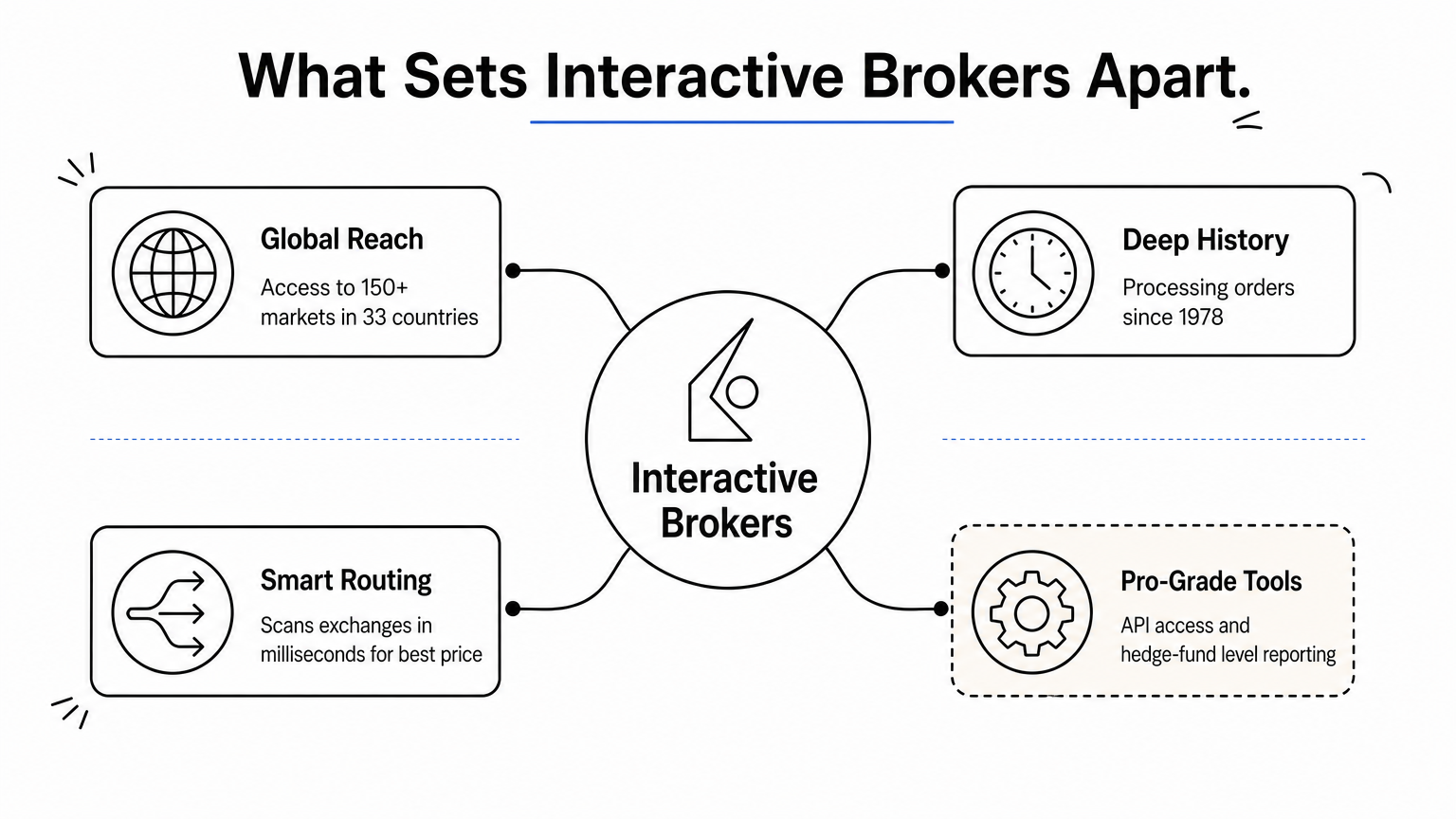
You have narrowed your search down to Interactive Brokers, and now you want a straight answer instead of another recycled press release. This Forex Broker review breaks down what actually matters: fees, platform quality, regulation, and whether the account experience holds up once real money is on the line in 2026.
Interactive Brokers built its reputation on low-cost execution and access to markets most brokers never touch, from US equities to global futures and bonds. But "cheap" doesn't automatically mean "right for you." Beginners often find the Trader Workstation platform intimidating, and the account setup process can feel slower than newer, app-first brokers.
We'll walk through pricing tiers, account minimums, customer support quality, and how IBKR compares against brokers that offer deposit bonuses and promotions, since that's often the deciding factor for cost-conscious traders. By the end, you'll know exactly whether Interactive Brokers fits your trading style or if a bonus-driven alternative makes more sense for your capital right now.
Why Interactive Brokers still leads the broker conversation
Ask ten experienced traders which broker they respect most, and Interactive Brokers comes up in at least seven of those answers. That's not hype. The firm has been processing orders since 1978, went public on Nasdaq in 2007, and now clears trades for millions of accounts worldwide. When you're doing an Forex Broker review, you're not evaluating a startup chasing app-store downloads. You're evaluating decades of market infrastructure that most competitors simply can't replicate.
A reputation built on decades, not marketing
Scale is the first thing that separates Interactive Brokers from almost everyone else in this space. You get direct access to over 150 markets across 33 countries, all from one account, without needing separate logins for stocks, options, futures, forex, and bonds. That single-account structure matters more than it sounds like it should, because it means your margin, your reporting, and your tax documents stay in one place instead of scattered across five different platforms.
|
Asset Class |
Markets Covered |
Typical Use Case |
|---|---|---|
|
Stocks & ETFs |
90+ exchanges globally |
Long-term investing, swing trading |
|
Forex |
24 major/minor pairs, spot FX |
Currency trading, hedging |
|
Futures & Options |
CME, ICE, Eurex, and more |
Speculation, portfolio hedging |
|
Bonds |
US Treasuries, corporate, municipal |
Fixed income allocation |
|
Mutual Funds |
40,000+ funds |
Passive investing |
Why professionals still choose IBKR
Professional traders gravitate toward Interactive Brokers because the execution quality actually shows up in their P&L. The SMART order routing system scans multiple exchanges in milliseconds to find the best available price, something retail-focused brokers rarely bother building. Add in margin rates that sit well below industry average, an API for algorithmic trading, and reporting tools detailed enough to satisfy a hedge fund's compliance department, and you understand why serious traders treat this interactive brokers review conversation differently than they treat reviews of app-based competitors.
Interactive Brokers wins on infrastructure and cost, not on hand-holding.
Where IBKR falls short for casual traders
Casual traders, though, often hit friction almost immediately. Trader Workstation, the flagship platform, was designed for professionals managing complex portfolios, not for someone opening their first account. The interface throws dozens of order types and data panels at you before you've placed a single trade. Menus feel dense. Tooltips are sparse. Someone coming from a simplified mobile-first broker can spend a genuine hour just finding the order entry screen, and that learning curve pushes some beginners toward simpler alternatives before they ever give IBKR a fair shot.
The bonus gap that matters to cost-conscious traders
Here's the part most glossy reviews skip. Interactive Brokers doesn't run no-deposit bonuses or deposit-match promotions, and it never has. Its business model is built on tight spreads and low commissions, not on giving away bonus capital to attract new accounts. That's a deliberate choice, and it's not wrong, but it does mean a trader with a smaller account and a preference for risk-free bonus funds will find nothing here.
Compare that to forex-focused brokers that actively compete on promotions:
-
Welcome bonuses that add bonus capital on first deposit
-
No-deposit bonuses letting new traders test live conditions without funding an account
-
Cashback rebates tied to trading volume
-
Deposit-match programs that scale with account size
If that kind of promotional structure fits how you want to start trading, our updated forex no deposit bonus list lays out current offers from brokers like JustMarkets, XM, and RoboForex side by side, so you can weigh bonus value against the same fee and regulation criteria used throughout this review.
How to open and set up an Interactive Brokers account
Opening an account with Interactive Brokers takes longer than swiping through a mobile-first broker's onboarding, but the process is thorough for a reason: this is a fully regulated brokerage handling global market access, not a simplified trading app. Expect to spend 20 to 30 minutes on the initial application, then wait one to three business days for account approval, depending on your country of residence and the account type you select.
What you'll need before you start
Before you sit down to apply, gather your documents. Interactive Brokers verifies identity and financial background more rigorously than most retail-focused brokers, and incomplete applications get stuck in review queues.
-
Government-issued ID (passport or national ID card)
-
Proof of address dated within the last 3-6 months (utility bill or bank statement)
-
Employment and income information, including estimated net worth
-
Trading experience details, since IBKR gates access to options, futures, and margin based on your answers
-
Bank account details for your initial funding transfer
Choosing the right account type
Selecting an account type shapes what you can trade and how much control you get immediately. Interactive Brokers offers several structures, and picking the wrong one at signup can mean extra paperwork later if you need to upgrade.
|
Account Type |
Best For |
Minimum Deposit |
Margin Access |
|---|---|---|---|
|
Cash Account |
Beginners avoiding leverage |
$0 |
No |
|
Margin Account |
Active traders needing leverage |
$2,000 |
Yes |
|
IBKR Lite |
Casual US stock/ETF investors |
$0 |
Limited |
|
IBKR Pro |
Active traders wanting lower commissions |
$0 |
Yes |
Choose your account type based on how you'll actually trade, not what sounds most advanced.
Verification and first deposit
Approval hinges on document review, and Interactive Brokers cross-checks your identity against regulatory databases before releasing full trading access. Once approved, you'll fund the account via bank wire or ACH transfer, though wire transfers post faster if you want to start trading within a day or two. Some jurisdictions also support instant funding through third-party services, which shortens the wait considerably when you're eager to place your first trade, unlike a welcome account for new forex traders that funds itself the moment you register.

Lastly, take the platform tutorials seriously before placing your first live trade. Interactive Brokers offers a paper trading account with $1 million in virtual funds, and running through order types there first will save you from fat-fingering an order on Trader Workstation once real capital is on the line.
Interactive Brokers fees, commissions, and margin rates
Cost is where Interactive Brokers separates itself from nearly every other broker in this comparison, and it's the section most readers of this Forex Broker review actually came for. IBKR runs two pricing structures, Tiered and Fixed, and picking the right one depends entirely on your trading volume. Tiered pricing rewards active traders with commissions that shrink as your monthly share volume grows, while Fixed pricing keeps a flat per-share rate that's easier to predict if you trade infrequently.
Commission structure that scales with volume
Active traders benefit most from Tiered pricing, since IBKR drops the per-share rate the more you trade, sometimes down to a fraction of a cent per share for high-volume accounts. Casual investors, on the other hand, often prefer Fixed pricing because there's no guesswork involved in calculating a trade's cost before placing it.
|
Trade Type |
IBKR Pro Commission |
Typical Competitor Rate |
|---|---|---|
|
US Stocks/ETFs |
$0.0005–$0.0035/share |
$0.005–$0.01/share |
|
Options |
$0.15–$0.65/contract |
$0.65–$1.00/contract |
|
Futures |
$0.25–$0.85/contract |
$0.85–$2.25/contract |
|
Forex |
0.08–0.20 basis points |
0.20–0.40 basis points |
Interactive Brokers charges less than almost anyone else in the industry, and that gap compounds fast for active traders.
Margin rates that undercut nearly everyone
Margin borrowing is where IBKR's cost advantage becomes hard to ignore. Rates start around 5.83% for smaller balances and drop below 5% once your borrowed amount climbs past $100,000, according to the Interactive Brokers margin schedule. Competing brokers routinely charge 8% to 10% on comparable balances, which means a trader carrying a $50,000 margin position could save several hundred dollars a year simply by holding the account at IBKR instead of a retail-focused alternative.
Hidden costs worth checking before you fund an account
Nothing here is truly hidden, but a few line items catch new users off guard. IBKR charges a small inactivity-adjacent data fee if you subscribe to premium market data packages, though basic quotes remain free. Currency conversion fees apply when you trade instruments denominated in a currency different from your base account currency, typically running around 0.002% of the converted amount. Withdrawal fees are minimal, usually one free withdrawal per month with a modest charge afterward.
Zero-commission or bonus-driven brokers can look cheaper at first glance, especially for a trader focused on no-deposit bonuses rather than raw execution cost. But once you factor in wider spreads that many of those brokers build into pricing, IBKR's transparent, itemized fee structure often wins out for anyone trading beyond a handful of positions a month. If bonus capital still matters more to you than commission savings, our bonus comparison directory breaks down which brokers offset their spreads with deposit bonus forex offers instead.
IBKR trading platforms and tools compared
Platform choice matters as much as pricing when you're weighing an Forex Broker review, because the software you trade on directly shapes how fast you execute and how much you understand your own risk. Interactive Brokers offers three distinct entry points depending on how deep you want to go, and each one serves a different kind of trader rather than competing for the same user.
Trader Workstation for power users
Trader Workstation, or TWS, remains the flagship product, and it's built for someone managing dozens of positions across asset classes at once. You get customizable trading screens, real-time risk analytics, options strategy builders, and a full algorithmic trading interface through the IBKR API. Serious options traders lean on the OptionTrader module to model spreads before entering a position, and futures traders use the same platform to hedge across contracts without switching windows. The tradeoff is steep: TWS demands a real time investment to learn, and casual traders often feel overwhelmed by the sheer density of the interface before they've placed a single order.
IBKR Mobile and Client Portal for simplicity
Simplicity comes from the other two options in the lineup. IBKR Mobile strips the experience down to a clean, app-first design that handles order entry, portfolio monitoring, and basic charting without the clutter TWS piles on. Client Portal, accessed through a browser, sits between the two, giving you account management, statements, and simplified trading without installing desktop software. Neither replaces TWS for complex strategies, but both make day-to-day account management genuinely painless, and most beginners end up living in one of these two interfaces rather than TWS itself.
The right platform is the one that matches your trading complexity, not the one with the most features.
Tools that go beyond order entry
Research tools round out the package, and this is where Interactive Brokers quietly outpaces most competitors. You get access to third-party research from Morningstar, Zacks, and Reuters bundled into the platform, plus a Portfolio Analyst tool that breaks down performance attribution across your entire account.
|
Tool |
Best For |
Learning Curve |
|---|---|---|
|
Trader Workstation |
Active traders, options/futures |
High |
|
IBKR Mobile |
Quick trades, monitoring on the go |
Low |
|
Client Portal |
Account management, statements |
Low |
|
IBKR API |
Algorithmic and automated trading |
High |
Anyone building automated strategies will appreciate the API's depth, since it supports Python, Java, and C++ integrations that most retail brokers never bother offering. For most traders reading this review, the honest takeaway is simple: start on Mobile or Client Portal, and only graduate to TWS once your strategy actually demands the extra horsepower.
Is Interactive Brokers safe and well regulated
Safety is the question that matters most once you've decided the fees and platforms work for you, and it's the one part of this Forex Broker review where Interactive Brokers has almost no weak spots. The company operates as a publicly traded firm on Nasdaq under the ticker IBKR, files audited financials every quarter, and has survived multiple market crashes without a liquidity scare that touched client accounts. That track record matters more than marketing copy, because a broker's real test isn't a calm market, it's a volatile one.
Regulatory oversight across multiple jurisdictions
Regulation at Interactive Brokers isn't a single license in a convenient offshore jurisdiction. The firm operates through separate regulated entities depending on where you open your account, and each entity answers to a serious regulator rather than a rubber-stamp authority.
|
Region |
Regulator |
Entity |
|---|---|---|
|
United States |
SEC, FINRA |
Interactive Brokers LLC |
|
United Kingdom |
FCA |
Interactive Brokers (U.K.) Limited |
|
European Union |
CBI (Ireland) |
Interactive Brokers Ireland Limited |
|
Australia |
ASIC |
Interactive Brokers Australia Pty Ltd |
|
Hong Kong |
SFC |
Interactive Brokers Hong Kong Limited |
That multi-jurisdiction structure means a trader in Malaysia or Hong Kong isn't relying on a distant US regulator for protection; they're covered by a locally licensed entity held to that region's own standards, according to details published on the Interactive Brokers regulatory information page.
How your funds are protected
Protection of client assets goes beyond the license itself. US accounts get SIPC coverage up to $500,000, including $250,000 for cash, and Interactive Brokers carries additional excess-SIPC insurance through Lloyd's of London that raises total coverage well past the standard limit. Client securities sit in segregated accounts separate from the firm's own capital, which means your holdings aren't exposed if the company itself ran into financial trouble.
A broker's safety shows up not in its marketing, but in whether your assets stay untouched if the firm fails.
Financial stability signals worth checking yourself
Verifying safety yourself takes ten minutes, and it's worth doing before you fund any account. Interactive Brokers Group publishes its balance sheet, capital ratios, and risk disclosures publicly, since it's a listed company subject to SEC reporting requirements. You can check the firm's excess regulatory capital, which routinely sits several times above what regulators require, a buffer most bonus-driven forex brokers simply don't disclose or maintain at the same scale. If you're comparing IBKR against a broker offering a no-deposit bonus or deposit-match promotion, run the same check on that broker's regulatory filings before assuming the bonus outweighs the risk, or start with brokers whose no-deposit bonus offers have been verified. Our broker directory lists which regulated brokers offer a forex free bonus so you can compare that safety profile alongside the promotion itself.
Pros and cons of trading with Interactive Brokers
Weighing the good against the bad is the whole point of any honest Forex Broker review, and Interactive Brokers earns a mixed verdict depending entirely on who's asking. A day trader running options spreads across five exchanges will read this list completely differently than someone opening their first brokerage account with $500. Both readers deserve a clear picture, so here's the breakdown without the marketing gloss.

What works in IBKR's favor
Strength shows up most clearly once you compare the account against the rest of the industry rather than judging it in isolation. The low commission structure covered earlier translates into real savings for anyone trading more than a few times a month, and the margin rates beat almost every retail competitor by a wide margin.
-
Deep market access across 150+ markets in 33 countries from one account
-
Rock-bottom margin rates that drop below 5% on larger balances
-
Institutional-grade execution through SMART order routing
-
Strong regulatory coverage across SEC, FCA, ASIC, and other major regulators
-
Robust API access for algorithmic and automated trading strategies
A broker's fee sheet only matters once its execution and safety hold up, and Interactive Brokers checks both boxes.
Where the drawbacks show up
Drawbacks cluster almost entirely around accessibility rather than substance. Trader Workstation remains the biggest hurdle for anyone new to trading, and the account opening process moves slower than app-first brokers built around one-tap signups.
-
Steep learning curve on Trader Workstation for beginners
-
No promotional bonuses, unlike many forex-focused competitors
-
Complex account structures that can confuse first-time applicants
-
Data fees for premium market data subscriptions
-
Overkill for casual investors who only need basic stock buying
Who should think twice before opening an account
Thinking through fit matters more here than with most brokers, because Interactive Brokers rewards volume and punishes inattention. Someone placing a handful of trades a year, with a small account and a preference for testing a broker risk-free before committing real capital, often gets more value from a promotional forex broker than from IBKR's raw cost savings. Similarly, a trader who weighs the pros and cons of forex no deposit bonuses as a way to build starting capital won't find that option here at all, since it simply doesn't fit the firm's business model.
Ultimately, the pros and cons balance out cleanly along one line: experience level and trading frequency. Veterans managing serious volume gain more from IBKR's pricing and infrastructure than they lose from its complexity. Beginners with smaller accounts, meanwhile, might get more practical value comparing forex brokers offering a no deposit bonus side by side before committing to a platform that assumes you already know what you're doing.
Interactive Brokers vs other popular brokers
Context makes any Forex Broker review more useful, and Interactive Brokers looks different depending on which competitor you line it up against. Judged against traditional US discount brokers, IBKR wins on cost and market access but loses ground on simplicity. Judged against forex-focused brokers built around promotions, the comparison flips entirely, since those brokers compete on bonus capital rather than raw execution quality.
IBKR against traditional discount brokers
Brokers like Fidelity and Charles Schwab compete directly with Interactive Brokers for the same US-based investor, and the differences show up fast once you compare fee sheets side by side. Schwab and Fidelity offer commission-free stock and ETF trades, matching IBKR Lite on the surface, but neither comes close to IBKR's global market reach or its margin rates once you start borrowing meaningfully. Where those brokers pull ahead is customer support depth and branch access, which matters if you want a human on the phone rather than a support ticket, though a broker comparison on spreads and execution speed tells a different story.
|
Factor |
Interactive Brokers |
Traditional US Broker (Fidelity/Schwab) |
|---|---|---|
|
Stock/ETF Commissions |
$0 (Lite) / low per-share (Pro) |
$0 |
|
Global Market Access |
150+ markets, 33 countries |
Mostly US-focused |
|
Margin Rates |
5.83% and dropping |
8%+ typically |
|
Platform Complexity |
High (TWS) |
Low to moderate |
|
Bonus Promotions |
None |
Occasional cash bonuses |
The broker that wins on paper isn't always the broker that fits your actual trading habits.
IBKR against forex-focused, bonus-driven brokers
Forex brokers built around promotions play an entirely different game, and that's where the comparison gets most relevant for readers of this site. Brokers like JustMarkets, XM, and RoboForex actively compete on welcome bonuses and deposit-match offers, something Interactive Brokers has never offered and structurally can't, given its regulatory footprint in markets like the US, UK, and Australia. Newer traders testing a strategy with limited capital often value that bonus structure more than IBKR's tighter spreads, especially when the bonus lets them trade live conditions without risking their own deposit first.
Specifically, the tradeoff comes down to three factors:
-
Cost per trade: IBKR wins for high-volume traders; bonus brokers can offset spreads with promotional capital for smaller accounts.
-
Regulatory weight: IBKR's multi-jurisdiction licensing outweighs most forex-only brokers, though several featured brokers still hold solid tier-one or tier-two licenses.
-
Starting capital needs: Bonus-driven brokers lower the barrier to entry; IBKR assumes you're funding the account yourself.
Neither approach is objectively better, and pretending otherwise misses the point of this comparison. Traders who prioritize execution quality and long-term cost savings should lean toward IBKR. Traders who want to test a broker's live conditions before committing real money should compare the current offers in our broker bonus directory, where promotions from JustMarkets, XM, and our detailed RoboForex broker review sit alongside their regulatory details for a fair side-by-side look.
Common questions traders ask about Interactive Brokers
Questions about Interactive Brokers tend to repeat across forums and comment sections, and most of them come down to fit rather than legitimacy. Below are the ones we see most often from readers researching an Forex Broker review before they commit real money.
Is Interactive Brokers good for beginners?
Beginners can absolutely use Interactive Brokers, but they should start on IBKR Lite or the Client Portal rather than jumping straight into Trader Workstation. Lite accounts carry no minimum deposit and skip most of the platform's advanced clutter, which makes the learning curve manageable. Someone who wants a gentler on-ramp with built-in incentives, though, might still prefer one of the top forex brokers with the best welcome bonus, since that structure rewards a first deposit in a way IBKR never will.
Does Interactive Brokers offer bonuses or promotions?
No, and this is the question we get asked most. Interactive Brokers has never run no-deposit bonuses, deposit-match offers, or cashback promotions, and its regulatory footprint in the US, UK, and Australia makes that kind of incentive structure unlikely going forward. Traders who specifically want bonus capital to test live trading conditions should browse our forex bonus offers instead of waiting for IBKR to change its model.
If bonus capital is part of your decision, Interactive Brokers was never built to compete on that front.
What's the minimum deposit to open an account?
Minimums vary by account type rather than applying universally. IBKR Lite and Cash accounts require $0 to open, while a Margin account typically asks for around $2,000 before leverage becomes available. That flexibility means a trader with limited starting capital isn't locked out, much like the best forex brokers with a low minimum deposit, though margin privileges and some data subscriptions still depend on funding thresholds.
Can international traders use Interactive Brokers?
Yes, and this is one of IBKR's genuine strengths. The firm operates regulated entities across the US, UK, EU, Australia, and Hong Kong, so traders in Malaysia, Indonesia, Thailand, and dozens of other countries can open accounts through a locally licensed subsidiary rather than a distant offshore shell. Availability and account features do shift slightly by jurisdiction, so check the specific entity covering your country before assuming every feature applies equally.
How does customer support compare to other brokers?
Support at Interactive Brokers leans toward self-service, with an extensive knowledge base and ticket-based help rather than the phone-first model traditional brokers offer. Live chat exists and generally responds within minutes during market hours, but traders used to picking up the phone at Fidelity or Schwab sometimes find IBKR's support slower for anything beyond a quick account question. It works fine for self-directed traders; it frustrates anyone who wants hand-holding through their first few trades.
The bottom line on Interactive Brokers
Interactive Brokers earns its reputation through decades of infrastructure, tight commissions, and regulatory coverage that few competitors can match. This Forex Broker review keeps coming back to one truth: IBKR rewards traders who already know what they're doing and trade often enough to feel the fee savings. It punishes nobody, but it also hands nothing to beginners looking for a softer landing or free capital to test the waters.
If you've got volume and patience for Trader Workstation, few brokers beat IBKR on raw execution and cost. If you're starting smaller and want bonus capital or a gentler entry point, that's simply not what this broker offers, and pretending otherwise wastes your time. Compare the best forex brokers with bonus offers before you fund any account, and pick the structure that actually matches your starting capital, not just the broker with the biggest name.
This in-depth review of Interactive Brokers (IBKR) examines whether the firm's reputation for low-cost execution and global market access, spanning over 150 markets in 33 countries since 1978, justifies choosing it in 2026. The article covers IBKR's tiered and fixed commission structures, industry-leading margin rates starting around 5.83%, and multi-jurisdiction regulation under SEC, FCA, ASIC, and CBI, backed by SIPC coverage and excess insurance through Lloyd's of London. It details account setup, required documents, and account types like Cash, Margin, IBKR Lite, and Pro, plus platform options ranging from the powerful but complex Trader Workstation to simpler IBKR Mobile and Client Portal interfaces. A recurring theme is IBKR's total absence of deposit bonuses or promotions, unlike forex-focused competitors such as JustMarkets, XM, and RoboForex, which compete on welcome bonuses and cashback. The review weighs pros (deep market access, low fees, strong regulation, robust API) against cons (steep learning curve, no promotions, complex onboarding), concluding that IBKR best suits experienced, high-volume traders, while beginners or smaller accounts seeking bonus capital or simplicity may be better served by promotional forex brokers instead.